
2026-09-03 ·
Mold in Attics With Bathroom Exhaust Fans Vented Wrong
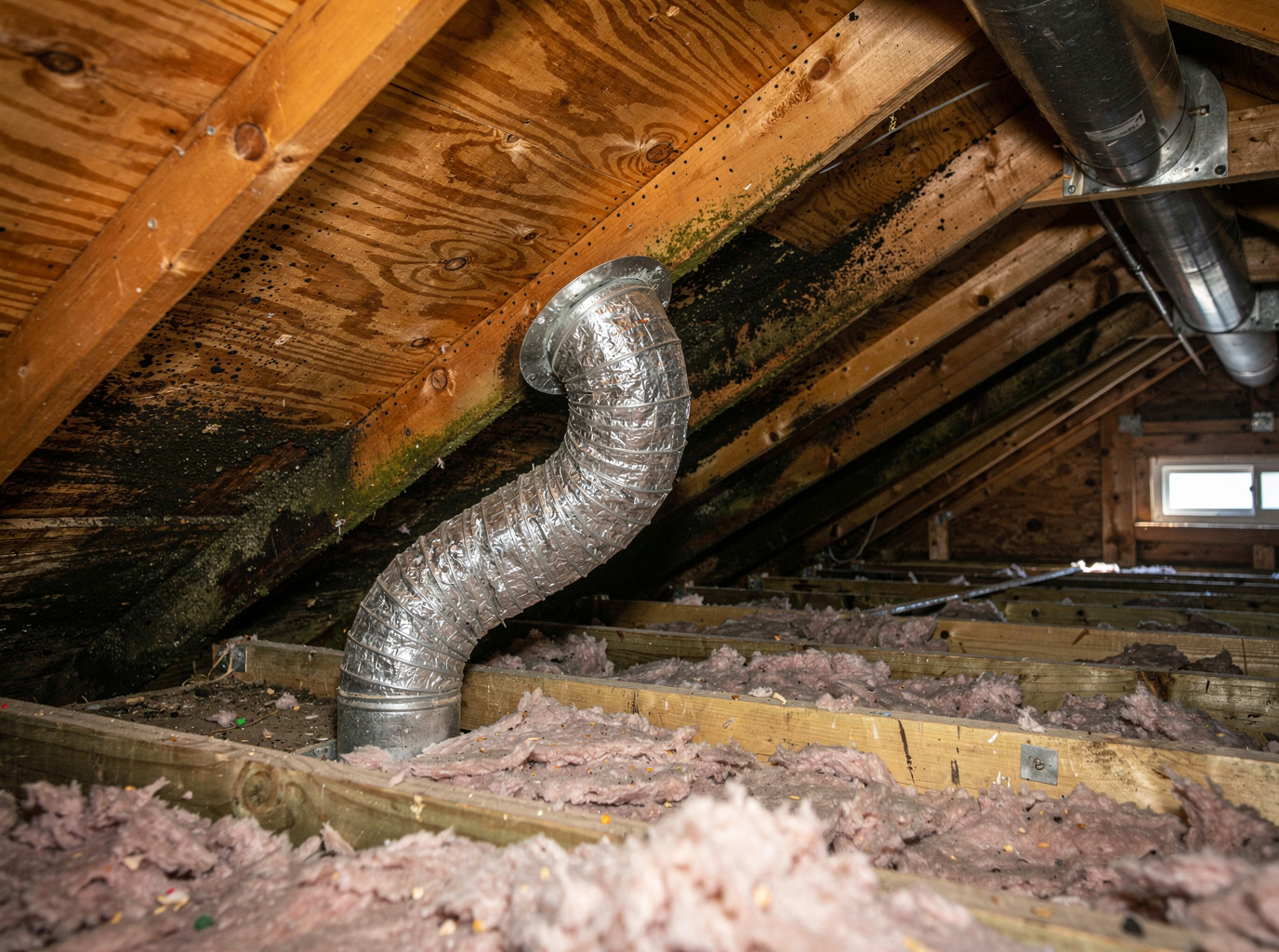
Bathroom exhaust fans vented into the attic instead of outdoors dump warm, humid shower air onto insulation and roof sheathing. In Rochester’s humid continental climate with cold snowy winters, that moisture condenses on cold wood, and mold can colonize rafters, kraft facing, and cellulose in 2–4 weeks of daily use. Many Park Avenue, East Avenue, and Charlotte houses still have 1920s–1950s fans that stop short of a roof or gable cap.
Why Wrong Venting Grows Mold in Rochester Attics
Monroe County attics sit above living space that is heated while the roof deck stays near outdoor temperature. A 4-inch flex duct that dumps into the rafter bay adds several pints of water per shower. Once winter temperatures drop, that vapor hits 20–30°F sheathing and condenses. Ice dams along the eaves then trap even more moisture. Homes near High Falls and the Rochester Public Market often have balloon framing and little soffit intake, so the extra humidity has nowhere to go. Cellulose packed against the deck stays damp for days. Cladosporium and Aspergillus show up first as gray-black spotting on the underside of the plywood. Left alone, hyphae reach the top plates and can stain the ceiling below. Nearby Brighton, Irondequoit, and Pittsford stock from the same era repeats the pattern whenever a remodeler tied a new fan into an old, uninsulated run.
How Bathroom Fans Get Dumped Into the Attic
The typical failure is a short rigid or foil duct that ends 2–6 feet from the fan housing, taped to a joist or simply left open. Builders in the 1950s treated the attic as “outside.” Later owners added a second bath and reused the same chase. In East Avenue Tudors the chase often collides with a chimney, so the installer cut the duct and called it done. You can confirm it from the living space: after a 10-minute shower the attic hatch feels warm and smells like a locker room. From above, look for a wet ring in the insulation, dark staining on the nearest rafter, and frost on nails in January. A moisture source identification walk-through maps the duct path and measures relative humidity at the deck. If the fan is undersized (under 80 CFM for a 50-square-foot bath), even a correctly terminated run can backdraft. Upgrading the fan and running insulated rigid pipe through a roof cap is the only lasting fix; see bathroom exhaust fan upgrade for how that work is sequenced with containment.
What We See in Park Avenue, East Avenue, and Charlotte Homes
Park Avenue two-flats often share a single attic with two baths dumping into the same bay. East Avenue colonials near the George Eastman Museum have steep roofs and limited ridge venting, so steam pools at the peak. Charlotte cottages closer to the lake take extra wind-driven snow that seals soffits, turning a small leak into a wet blanket of cellulose. In all three neighborhoods the housing stock is wood-framed, frequently with original plaster and later blown-in fill. Mold follows the wet path: first the facing paper, then the wood, then the drywall at the top plate. Spore counts in still air can jump 3–5 times outdoor levels after a week of showers. Irondequoit and Pittsford ranches from the 1960s show the same dump-and-forget ducts, just with shallower attics that freeze faster. We do not invent square-footage or job counts; we simply open the hatch, follow the flex, and photograph the stain. Hours are Mon–Fri 8am–6pm and Sat 9am–2pm from 1925 S Clinton Ave, Rochester, NY 14618.
Fixing the Fan and Treating the Mold
Stop using the bath fan until the duct is rerouted outdoors. Contain the attic with plastic and negative air, then HEPA-vacuum loose spores. Wet cellulose that stays above 20% moisture gets bagged and removed; dry fiberglass can often be treated in place. Wood framing is cleaned and coated so remaining hyphae cannot recolonize. Only after the moisture source is gone does attic mold remediation make sense. A new 4-inch insulated rigid run to a roof cap, sealed at every joint, plus a 110 CFM fan with a 20-minute timer, keeps the deck dry. In lake-effect winters, check that soffits are open so the new exhaust can leave; checking attic ventilation after heavy lake effect snow walks through that inspection. Post-work humidity should sit under 50% at the sheathing. We give upfront quotes based on what is visible, not warranties we cannot support. Brighton and Irondequoit jobs follow the same sequence because the climate and the era of construction are the same.
Keeping Attics Dry Through Rochester Winters
Run the new fan during every shower and for 20 minutes after. Keep attic RH in check with a small monitor at the hatch. After a heavy snow, clear soffits so intake air can replace the exhausted moisture. If you smell must again, stop and look at the duct before staining spreads. Owner-operated work from Clinton Ave means you can inspect the roof cap and the cleaned rafters yourself. Do not add more insulation over a wet dump; that only hides the problem until spring. Correct termination plus ordinary winter habits stops the cycle that Park Avenue, East Avenue, and Charlotte attics have repeated for decades.