
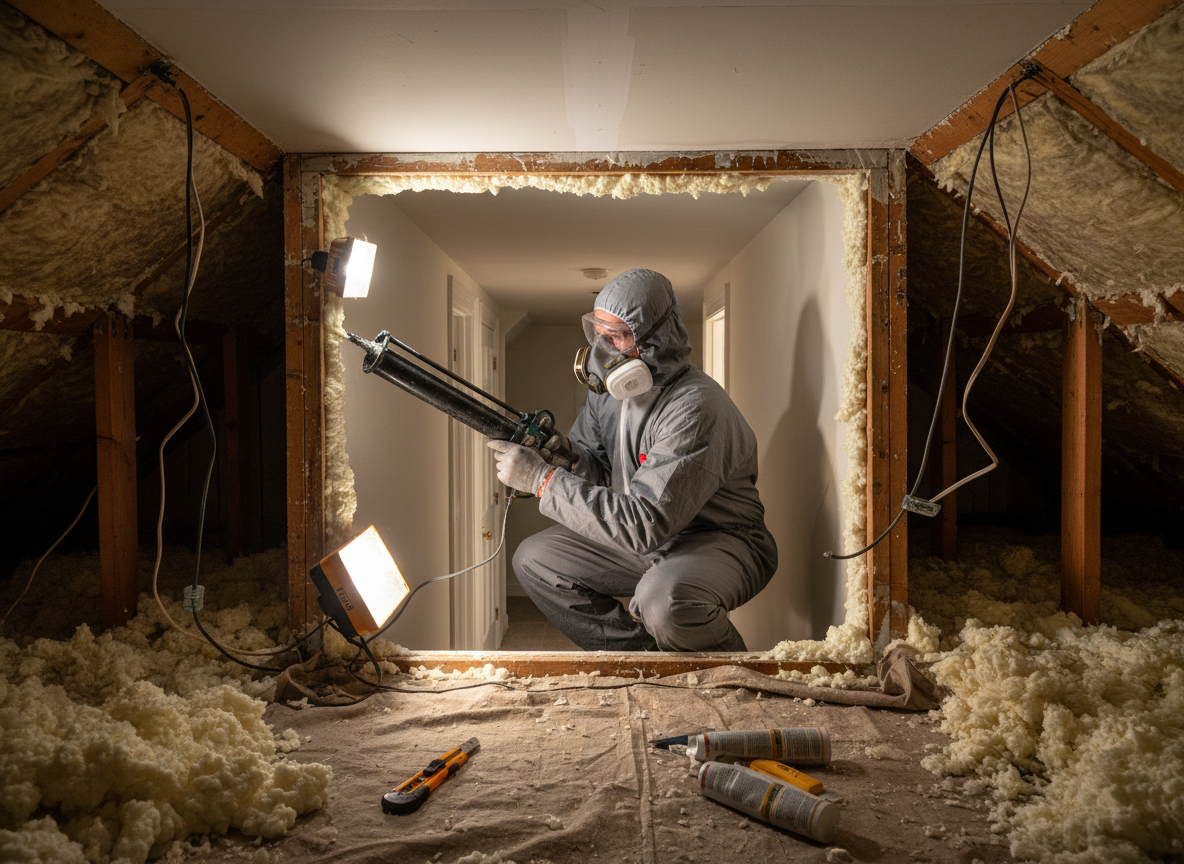
Rochester’s humid continental winters drive a strong stack effect: warm, moisture-laden air from living space wants to rise through every gap in the attic floor. An unsealed hatch on Park Avenue or East Avenue bungalows and colonials is often the largest hole left after insulation is blown. Once snow sits on the roof and attic temperatures drop, that air condenses on sheathing and rafters. Sealing the access is not cosmetic; it is the first control that keeps bathroom and kitchen humidity from feeding attic mold after a lake-effect event.
Housing stock in Monroe County is mixed: 1920s–1940s homes near the George Eastman Museum and along East Avenue often have rough-framed scuttles with no weatherstrip, while later Brighton and Pittsford ranches use thin plywood lids that sit on drywall. Charlotte cottages closer to the lake see more wind-driven moisture and need a tighter gasket. Pull-down stairs are common and almost never come from the factory with a continuous seal. We treat the opening as a conditioned-to-unconditioned plane, not a leftover construction hole.
Work starts with measuring the actual opening, not the lid. We add closed-cell foam gaskets or vinyl weatherstrip that compresses when the hatch is closed, then a rigid foam or mineral-wool cover that matches existing attic R-value so the lid is not a thermal short. Fasteners stay out of the living-space finish. If the hatch sits over a hallway near Rochester Public Market-area two-flats, we check that the new cover still clears the door swing. We do not claim code stamps; we leave a job you can open and inspect. Hours are Mon–Fri 8am–6pm and Sat 9am–2pm from 1925 S Clinton Ave.
Edge cases matter. Chimney chases that share the hatch bay, knob-and-tube still live in some East Avenue attics, and ice-dam melt that has already stained the hatch trim all change the sequence. We never bury active mold under a new cover; if staining is present we stop and address the source first. Irondequoit ranch hatches sometimes sit over plaster that crumbles when you add weight, so we sister a simple frame rather than hanging extra foam on failing drywall. The goal is a lid that stays shut through a Rochester winter without becoming the next leak.
Technician insight
In Rochester, the thing that catches most people out with attic access sealing is assuming the factory plywood lid is square. On Park Avenue and East Avenue houses the rough opening is often out of square from a century of settling, so a store-bought cover leaks at two corners all winter. Charlotte and Irondequoit homes add wind and lake moisture, so a gasket that looks fine in October fails after the first heavy snow if it is not compressed evenly.
Unsealed scuttle over a Brighton ranch hallway
A homeowner noticed frost on the hatch trim after a cold snap. We found a thin plywood lid sitting on drywall with no gasket and a two-inch insulation gap. We added a continuous foam weatherstrip, a fitted rigid cover, and checked that the hallway door still cleared. Condensation on the trim stopped on the next freeze.
Attic Access Sealing Services We Offer
✓Attic Hatch Weatherstripping
Compressible gasket around the scuttle so indoor air cannot leak past the lid during Monroe County freeze-thaw cycles.
✓Insulated Attic Door Covers
Rigid foam or mineral-wool boxes that sit over the hatch and match attic insulation depth so the opening is not a cold spot.
✓Pull-Down Stair Air Sealing
Weatherstrip, side gaskets, and a fitted cover for folding stairs common in Brighton and Pittsford ranches.
✓Knee Wall Access Panel Sealing
Gasket and latch work on Cape-style knee-wall doors found in older Park Avenue and East Avenue homes.
✓Scuttle Lid Rebuild and Fit
New plywood or foam-core lids cut to the real opening when the original board is warped or undersized.
✓Chimney-Bay Hatch Detailing
Extra sealing where the access shares a bay with a masonry chimney so stack-driven leaks do not bypass the gasket.
Attic Access Sealing Cost in Rochester, NY
| Service | Typical Range | What Affects It |
|---|---|---|
| Simple scuttle weatherstrip and foam lid | $175–$350 | Square opening, sound drywall, no stairs |
| Pull-down stair gasket and cover | $300–$650 | Hardware condition and stair width drive labor |
| Knee-wall panel seal and latch | $200–$450 | Irregular Cape framing in older East Avenue homes |
| Hatch plus chimney-bay detailing | $400–$800 | Extra foam and fire-aware detailing around masonry |
Ranges are typical for Rochester, NY and confirmed with an exact written quote before any work starts.
How it works
- 1
Inspect The Opening
We measure the hatch, note pull-down hardware, plaster condition, and any staining before recommending a gasket and cover.
- 2
Prep And Protect Living Space
Drop cloths go down in the hallway; we work from 1925 S Clinton Ave hours so you know when we will be in the house.
- 3
Install Gasket And Cover
Weatherstrip is applied to a clean, square landing; the insulated cover is fitted so it seats without crushing drywall.
- 4
Verify Closure And Access
You open and close the hatch with us present so the seal compresses and the stairs or lid still work after a snowy weekend.
Pricing
Most Rochester attic access sealing jobs fall in a modest materials-and-labor range; price moves with stair type, plaster condition, and whether a custom cover is needed—not a one-price flyer.